

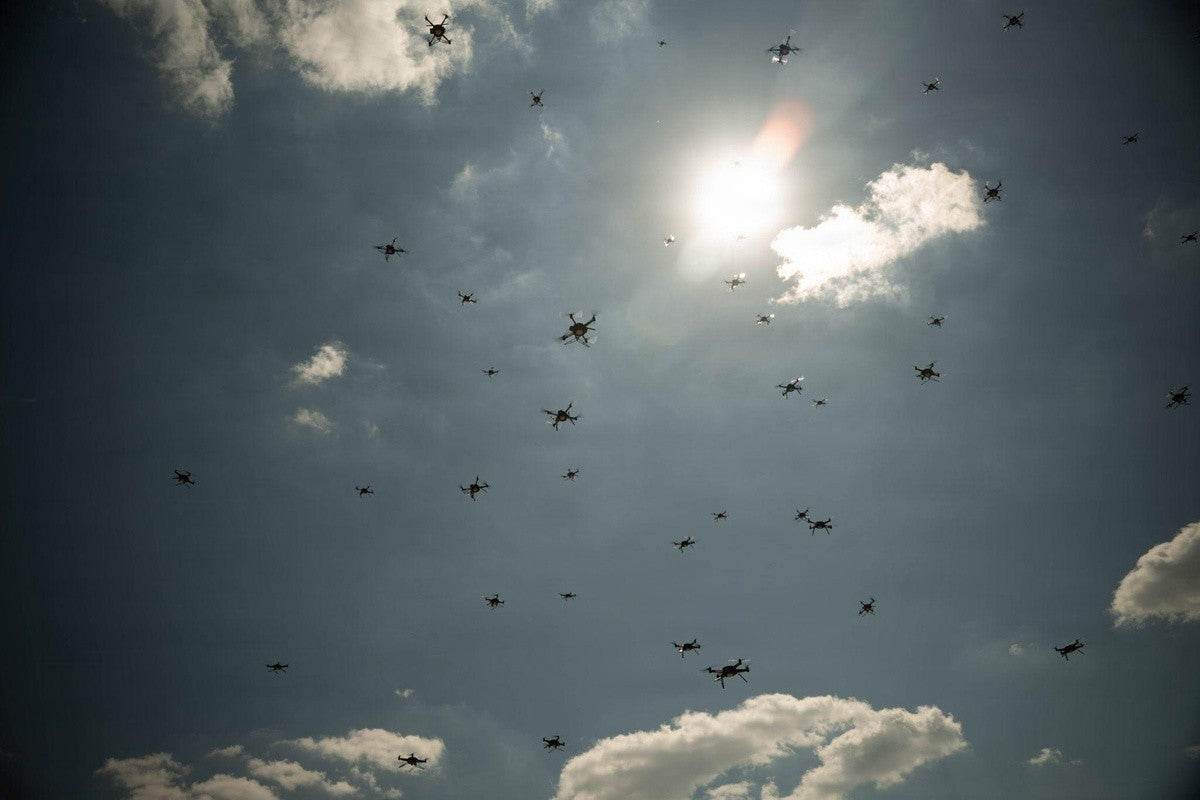
From September 11 to 17, the XVIII Airborne Corps turned Fort Bragg into a stress test for the next war. During Scarlet Dragon 26-3, soldiers faced down swarms of up to 100 drones at a time, mixed with other threat profiles, while the Corps tested how its sensors, command and control, air defenses, AI, electronic warfare, autonomous systems, and defensive fires actually work together across multiple echelons.
Most coverage of Scarlet Dragon frames it as a counter-drone story. That misses the harder lesson. A 100-drone swarm is not just an air-defense problem. It is a network problem and a spectrum problem, and it will break your comms plan before it breaks your perimeter.
Here is what the exercise tells every communicator, spectrum manager, and small-unit leader about operating under the swarm.
1. The spectrum saturates before the air defenses do
One hundred drones means one hundred-plus emitters: control links, video downlinks, telemetry, GPS, plus every friendly radio, radar, jammer, and sensor trying to operate in the same battlespace. Long before a single drone reaches its target, the electromagnetic spectrum around the objective is saturated.
This is the part of the drone fight that does not show up in highlight reels. Your mesh network, your ATAK feeds, your FM voice nets, and your counter-UAS sensors are all competing for the same finite electromagnetic terrain. Scarlet Dragon's whole premise, integrating EW and spectrum-dependent systems across echelons, is an admission that the EMS is now the decisive terrain in the drone fight. Plan for it like terrain: map it, recon it, and fight for the high ground before the first launch.
2. Friendly C2 vs. counter-UAS electronic warfare
Here is the fratricide problem nobody wants to brief: the same jammers and EW systems you turn on to kill the swarm will happily kill your own command and control. Wide-area GPS denial degrades your drones, your precision fires, and your blue-force tracking at the same time it degrades the enemy's. Blanking a control-link band does not discriminate between a hostile FPV and the ISR bird your commander is watching.
Scarlet Dragon tested EW integration across multiple echelons precisely because this deconfliction cannot be solved at the company level with a laminated card. It requires a spectrum plan that treats friendly emitters and threat emitters as one integrated picture, with kill authority, emission control windows, and pre-planned EW "off-ramps" so your own C2 survives the engagement. If your PACE plan does not account for your own jammers, you do not have a PACE plan. You have a wish.
3. The mothership problem: dynamic emitters and a lying threat picture
One of the notable wrinkles at Scarlet Dragon was a mothership drone that launched smaller drones in flight. That single detail complicates everything downstream: tracking, threat identification, and target prioritization all assume a relatively stable count of discrete contacts. A mothership turns the threat picture into a dynamic emitter problem, where the number, location, and signature of threats change mid-engagement.
For communicators, the lesson is about bandwidth and sensor fusion, not just kinetics. Every new contact the mothership spawns is another track that has to be detected, correlated, shared across echelons, and pushed to shooters, all over networks that are already saturated (see point one). Your C2 architecture has to scale track throughput at machine speed, or the common operating picture lags reality and shooters engage stale data. Design your networks for the surge, not the steady state.
4. PACE plans at machine speed
Traditional PACE, primary, alternate, contingency, emergency, assumes communications degrade in a sequence a human can manage: lose the primary, shift to the alternate, work down the list. A 100-drone swarm with active EW does not degrade your comms in sequence. It degrades them simultaneously and selectively, band by band, link by link.
The takeaway from an exercise like Scarlet Dragon is that PACE has to become a dynamic, spectrum-aware discipline rather than a static list. Know which of your links share spectrum with the threat, which survive GPS denial, and which die the moment wideband jamming starts. Pre-plan the transitions, rehearse them under jamming, and instrument them: if you cannot tell in real time which of your paths are alive, you cannot manage the failover. Automated link monitoring and pre-briefed emission shifts beat a radio operator frantically spinning dials.
5. The operator as sensor, and as incidental spectrum manager
Every soldier with a radio, a drone controller, or a personal electronic device is an emitter, and in a swarm-saturated environment, every emitter is either managed or it is interference. The Corps threw this problem at echelons from squad to corps because spectrum discipline is no longer a staff-section specialty. It is a soldier skill.
Train operators to think like incidental spectrum managers: power discipline, antenna discipline, transmission brevity, and an instinct for when their own emissions are the problem. The unit that keeps its electromagnetic signature tight is the unit whose sensors can still hear, whose C2 still works, and whose jammers can be aimed at the actual threat instead of fighting through friendly noise.
Hard answers
How do you plan comms for a swarm threat? Start from the EMS, not the radio. Map every friendly emitter, every threat band you expect, and every EW system you plan to turn on, then deconflict them the way you would deconflict airspace. The spectrum plan is the comms plan now.
Will jammers solve the swarm problem? Jammers are necessary and insufficient. They buy time and attrite the threat, but every jammer is also a giant "here I am" beacon that degrades friendly systems. The units that win the EW fight are the ones that integrate jamming with maneuver and fires, turning emitters on and off with the same discipline as a machine gun.
What should units train first? Three things, in order: operate under GPS denial until it is boring; rehearse comms failover under active jamming until it is muscle memory; and drill emission control until every operator treats their radio like a weapon with a signature. Scarlet Dragon exists because the Corps knows the next fight starts in the spectrum. Train like it.
The bottom line
Scarlet Dragon 26-3 was billed as a drone exercise. Read it as a systems exercise: one hundred drones exist to find the seams between your sensors, your networks, your EW, and your shooters, and then tear them open. The swarm is the stressor. The EMS is the terrain. Treat both accordingly, and your comms plan stops being the thing that breaks first.
Sources: U.S. Army, "America's Contingency Corps trains against the drone threat of the next war"; SOFX reporting on Scarlet Dragon 26-3. Exercise facts above are drawn from these reports; the communications and spectrum lessons are analysis.
0 comments